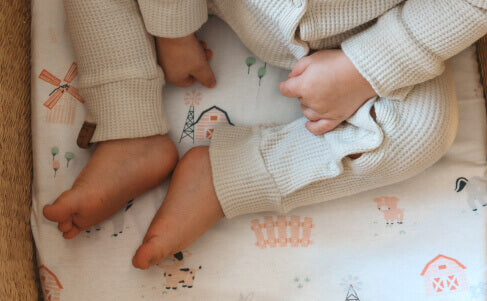


Why 100% Jersey Cotton Crib Sheets Are Safest for Your Baby's 20x30 Inch Mattress
Shopping for crib sheets, sized 20x30 inches, and seeing polyester blends everywhere? Wondering why some sheets feel soft in the packet but cause skin reactions after a few nights?
The material is almost always the reason. A compact mini crib sheet in the 20x30 inch range puts a baby in direct contact with a smaller surface area of fabric, which means what that fabric is made of matters even more per square inch. Polyester blends trap heat, carry dyes that are associated with skin reactions, and simply do not perform the way natural fibres do for a baby sleeping 14 to 18 hours a day. The size is non-universal, making it harder to shop for with fewer quality options.
This guide explains exactly why jersey cotton crib sheets are the safer choice at this size, what polyester-free actually means, and what OEKO-TEX certification confirms that a label saying 'soft' or 'gentle' never can.
- Crib sheets 20x30 inch are sized for unusually compact mini cribs and must be made from breathable, certified fabric: the smaller footprint means every material property is in more concentrated contact with the baby.
- Jersey cotton crib sheets outperform polyester on every metric that matters for infant sleep: breathability, skin safety, moisture management, and durability through high-frequency washing.
- Polyester-free baby sheets matter because disperse dyes used in synthetic textiles are among the most common causes of textile-related allergic contact dermatitis, and unlike cotton, polyester requires these dyes.
- Breathable mini crib sheets in jersey cotton support temperature regulation for a baby who cannot manage their own body heat: polyester traps heat against the skin surface
- OEKO-TEX crib sheets with Standard 100 Class 1 certification are tested for over 100 harmful substances at the strictest tier reserved for baby products under three years
Hypoallergenic baby bedding is only a verifiable claim when backed by OEKO-TEX or GOTS certification: without third-party testing, 'hypoallergenic' is unregulated marketing language.
Does the Material of a 20x30 Mini Crib Sheet Actually Matter?
Yes, and the compact dimensions of a 20x30 inch sheet make material quality more important, not less. The unusual size means shopping is harder, with fewer brands and stores stocking exactly what you need. A 20x30 sheet covers a smaller area, but a newborn lying on it still has their full body in contact with that surface for hours at a time.
That contact involves heat, moisture, skin chemistry, and whatever substances are present in the fabric. A breathable mini crib sheet made from jersey cotton manages that contact well. A polyester blend does not. The difference in material performance shows up practically in how the baby sleeps, how their skin responds over days and weeks, and how the sheet holds up through the washing schedule that compact mini crib use demands.
Is Polyester A Good Choice for Fitted Mini Crib Sheets?

Not really. They trap heat, shed toxic dyes, and trap moisture against the baby’s skin.
How Dangerous is Heat Trapping in Polyester?
Very. Polyester is a synthetic fibre with a closed, water-repelling structure. It does not absorb moisture and does not allow air to circulate through the fabric the way a knit cotton structure does. For an adult sleeping on a polyester sheet, this is uncomfortable. For a baby who cannot regulate their own body temperature and cannot remove themselves from a hot surface, it is genuinely problematic.
Babies who overheat during sleep show signs including sweating, flushed skin, and restlessness. Very young infants cannot wake themselves before the heat does real damage to their fragile bodies. A jersey cotton surface allows the heat to dissipate.
Are the Dyes on Polyester an Allergy Risk?
Polyester cannot be dyed with the reactive dyes used on cotton. Instead, it requires disperse dyes, a kind of synthetic dye that bonds loosely with the fibre and can move to the skin surface under conditions of heat and moisture, like those present around a sleeping baby. A 2022 review published in PubMed on textile allergies and contact dermatitis identified disperse dyes as among the most common causes of textile-related allergic contact dermatitis, noting that, unlike other dyes, they leach onto the skin.
This risk is worse for babies. A 2024 NIH study published in PubMed on childhood atopic dermatitis prevalence and household textile exposure found that xylene-derived polyester bedsheets were one of the worst culprits.
Cotton does not use disperse dyes. It uses reactive dyes that bond chemically with the fibre rather than sitting loosely on the surface. When a jersey cotton crib sheet is OEKO-TEX Class 1 certified, both the base cotton and the reactive dyes used on it have been independently tested.
Does Polyester Wick Away Moisture in a 20x30 Inch Fitted Sheet?
Polyester is hydrophobic, which means it repels moisture, and sweat stays on the skin surface rather than being wicked away. Cotton, on the other hand, is hydrophilic: it absorbs moisture from the skin surface and allows it to evaporate through the fabric.
A baby lying on a polyester sheet for several hours will stay damp for longer. That softens the skin barrier, increases its permeability, and creates conditions where irritants and allergens are absorbed more easily. On a cotton sheet, moisture is continuously moved away from the skin surface, keeping the contact environment drier.
Jersey Cotton vs Polyester: Head-to-Head for Baby Crib Sheets
Here’s how the two fabrics compare as fitted crib sheets:
|
Property |
100% Jersey Cotton |
Polyester or Polyester Blend |
|
Breathability |
High: knit structure allows air circulation and heat dissipation from the skin surface |
Low: closed hydrophobic fibre traps heat and moisture against the skin |
|
Moisture management |
Absorbs and wicks moisture away from the skin, keeping the contact surface drier |
Repels moisture: sweat sits on the skin surface, increasing barrier permeability over time |
|
Dye type |
Reactive dyes that bond with the cotton fibre and do not migrate to the skin |
Disperse dyes that sit loosely on the fibre surface and can leach onto the skin under heat and sweat |
|
Skin reaction risk |
Low: Reactive dyes on certified cotton have a well-established safety profile |
Higher: Disperse dyes are the leading cause of textile-related allergic contact dermatitis |
|
Stretch and fit |
Natural two-way stretch grips the mattress edge and holds flat through active infant sleep |
Synthetic stretch from elastane additives, no natural conforming properties |
|
Wash durability |
Maintains softness and elasticity through high-frequency washing at warm temperatures |
Can pill, stiffen, and develop static over repeated washing; disperse dyes fade faster |
|
Certifiable to OEKO-TEX Class 1? |
Yes: cotton-based fabrics with reactive dyes can meet the strictest infant-specific standard |
Technically possible but harder: disperse dyes face specific restrictions under Class 1 |
What OEKO-TEX Certification Says About a 20x30 Crib Sheet?
'Hypoallergenic', 'natural', 'gentle', or 'chemical-free' are all marketing terms without any third-party verification. OEKO-TEX Standard 100 Class 1 is a laboratory result, not a marketing claim.
For a 20x30 fitted crib sheet to carry Class 1 certification, the finished fabric must be submitted to an OEKO-TEX accredited laboratory and tested against over 100 parameters, including:
- Formaldehyde: zero tolerance under Class 1. Often used as a wrinkle-resistant finish during manufacturing, it is prohibited entirely in certified baby bedding
- Azo dyes releasing carcinogenic aromatic amines: strictly prohibited. Relevant to both the base fabric and any print or pattern applied to the sheet surface
- Heavy metals, including arsenic, cadmium, chromium, and nickel: tested and limited below Class 2 thresholds, reflecting the higher absorption risk in infant skin
- PFAS: per- and polyfluoroalkyl substances used in water-repellent finishes, restricted under Class 1
- pH: must fall within 4.0 to 7.5, the skin-neutral range, to avoid irritation from residual processing chemicals
- Pesticide residues: present in conventionally grown cotton, tested and limited under Class 1
Class 1 sets stricter limits than Class 2 across every substance it tests. A sheet certified to Class 2 does not meet standards for babies. Only Class 1 is appropriate for OEKO-TEX crib sheets used from birth. For a full breakdown of what each tested substance group means and why the classification matters, see our guide on why OEKO-TEX certified baby sheets are non-negotiable.
What OEKO-TEX Does Not Cover?
OEKO-TEX Standard 100 tests the finished fabric. It does not cover how the raw fibre was grown or whether the production chain meets environmental or ethical standards. GOTS certification covers those areas. For complete confidence in a sheet from fibre to finished product, GOTS plus OEKO-TEX Class 1 is the strongest combination.
Why Fit Matters as Much as Material for a 20x30 Sheet?
The 20x30 dimension is not a universal standard: it's the size range used by certain compact mini crib designs, and the actual mattress dimensions of different models within this range can vary by an inch or more in either direction. A sheet that's labelled 20x30 but is actually slightly too large will bunch across the sleep surface. One that's slightly too small will pop corners under tension.
The practical check: measure the mattress length, width, and depth before buying. Match those three dimensions to the sheet specification. Jersey cotton's natural stretch gives it some tolerance for minor dimensional variation, which is one reason it outperforms woven or synthetic fabrics on compact mattresses where the margin for error is smaller. For a full guide on how to measure and what to check, see our article on mini crib sheets that are soft, safe, and built to last.
Make sure the sheet has full-surround elastic to keep a breathable mini crib sheet flat through an active night without intervention.
How to Check the Fit After Washing?

After every wash: place the sheet on the mattress and check that it lies completely flat with no bunching, that the elastic grips the underside of all four corners without slack, and that no part of the sheet can be lifted more than an inch from the mattress surface without pulling the elastic taut.
What to Look for in a 20x30 Jersey Cotton Crib Sheet?
This call makes shopping for a fitted mini crib sheet so much easier:
|
Feature |
What to Look For |
Why It Matters at 20x30 Inch Scale |
|
Material |
100% jersey cotton, no polyester content |
Polyester dyes are a contact dermatitis risk; cotton's natural properties support infant skin safety |
|
Certification |
OEKO-TEX Standard 100 Class 1 |
Only third-party verification that covers dyes, finishes, and residues in the finished fabric at baby-specific limits |
|
Fit |
Exact match to mattress length, width, and depth |
20x30 is not universally standardised: a close-but-wrong size creates loose fabric that is a suffocation hazard |
|
Elastic type |
Full-surround |
On a smaller mattress perimeter, full-surround coverage matters more, not less |
|
Pre-washed |
Pre-washed or pre-shrunk |
Jersey cotton can shrink on the first wash: a sheet that no longer fits correctly after washing is unsafe |
|
Hypoallergenic claim |
Backed by OEKO-TEX Class 1 or GOTS, not a standalone marketing claim |
Unverified 'hypoallergenic' labels carry no regulated meaning: only certification confirms the finished product has been tested |
How Important is the Material For Fitted Mini Crib Sheets?
When it comes to crib sheets, 20x30 inch, the case for jersey cotton over polyester is not about preference or feel. It's about what the fabric does physiologically during an infant's sleep: whether it dissipates heat or traps it, whether its dyes stay in the fibre or migrate to the skin, whether moisture is managed away from the body or held against it.
OEKO-TEX Standard 100 Class 1 certification is the independent confirmation that a specific finished fabric, including its dyes and finishes, has been tested to the strictest standard appropriate for babies under three. It's the difference between a claim and a result. For a breathable mini crib sheet used from the first night, it's not optional.
What Is the Best 20x30 Jersey Cotton Sheets Certified to Class 1, That Is Ready From Night One?
At Joey + Joan, every jersey cotton crib sheet is made from 100% OEKO-TEX certified jersey cotton with no polyester, sized to specific mattress dimensions, including compact 20x30 mini crib models, with full-surround elastic. Our Farm Animals 2-pack is a popular choice for parents looking for a certified, polyester-free 20x30 sheet with a playful design that holds its print wash after wash. Each 2-pack is $29.99 and comes with a lifetime guarantee. Browse the full range of OEKO-TEX crib sheets at joeyandjoan.com/collections/all.
Frequently Asked Questions
Q. Why does jersey cotton stretch, but polyester does not?
Jersey is a knit fabric structure that creates natural two-way stretch from the looped construction of the cotton fibres: polyester sheets achieve stretch through added elastane, which has different performance properties under repeated washing.
Q. Is bamboo better than jersey cotton for a 20x30 baby sheet?
Bamboo viscose can be comparable in softness and breathability, but it is a semi-synthetic material processed with chemicals: always check for polyester content in the blend and verify OEKO-TEX Class 1 certification before buying.
Q. How do I know if a sheet labelled hypoallergenic has actually been tested?
Look for an OEKO-TEX Standard 100 Class 1 certificate number that can be verified on the OEKO-TEX website: without a verifiable certificate number, 'hypoallergenic' is a marketing claim with no independent testing behind it.
Q. Does washing a jersey cotton sheet in hot water affect its safety certification?
OEKO-TEX certification confirms the fabric composition, not a surface treatment, so the certified properties remain after washing: follow the care instructions to preserve elasticity and softness rather than to maintain certification.
Q. What is the pocket depth I need for a compact 20x30 mini crib mattress?
Most compact mini crib mattresses are approximately 2 inches thick: a pocket depth of at least 4 inches ensures the elastic can grip the full underside of the mattress edge without riding up and leaving the sheet loose overnight.
Sources
- Allergies Caused by Textiles: Control, Research and Future Perspective - A 2022 PubMed review on the state of research on allergy-causing textiles, including testing methods and future research direction.
- Spatial Modeling Connecting Childhood Atopic Dermatitis Prevalence with Household Textile Exposure - A 2024 NIH article that models the occurrence of childhood atopic dermatitis in relation to pollutant exposure.